

The Hidden Crisis in Pakistani Smiles: Why Access to Dental Care — and Gutka Use — Should Worry Us All
At Glam Aesthetics, we talk a lot about glowing skin and confident smiles. But this week, a story broke that made us pause: across Karachi and much of Sindh, public dental care is buckling under demand it simply can’t meet. And quietly, in the background, a habit as common as gutka or paan chewing is fueling a wave of preventable oral disease that most people don’t see coming until it’s serious.
Let’s unpack both — because they’re more connected than you might think.
A System Stretched Too Thin
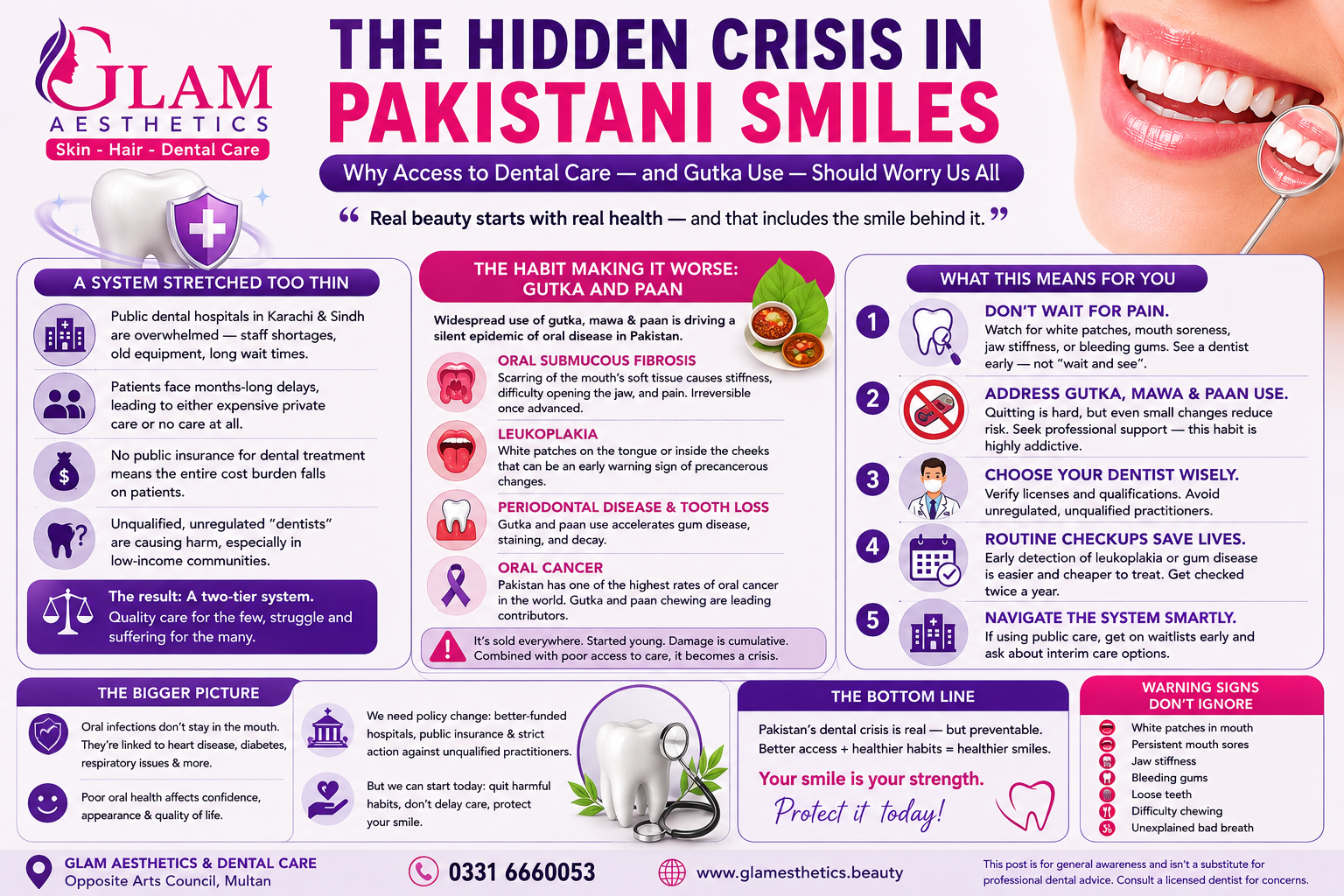
If you’ve ever tried to get a dental appointment at a public hospital in Pakistan, you probably already know the frustration. According to a recent report, government hospitals across Karachi and Sindh are struggling with shortages of specialist staff, aging equipment, and treatment capacity that hasn’t kept pace with demand. Patients are routinely told to come back months later — an unthinkable wait when you’re in pain or dealing with a worsening infection.
Faced with that kind of delay, most people do one of two things: pay out of pocket for private treatment they may not be able to afford, or simply skip care altogether. Neither option is good for long-term oral health. And unlike many other areas of medicine, Pakistan currently has no public insurance coverage for dental treatment — so the financial burden falls entirely on the patient.
The result is a two-tier system: those who can afford private clinics get timely, quality care, while everyone else is left to manage worsening dental issues on their own, or turn to unqualified “dentists” operating outside any real regulation — a problem experts have flagged as a growing source of harm, especially in lower-income communities where awareness of the risks is low.
The Habit Making It Worse: Gutka and Paan
Here’s where the crisis compounds itself. Even as access to care shrinks, one of the biggest drivers of oral disease in Pakistan keeps growing: the widespread, culturally normalized use of gutka and mawa (chewable tobacco-areca nut mixtures) and paan.
These aren’t just “bad habits” — they are directly linked to some of the most serious conditions a dentist can diagnose:
- Oral submucous fibrosis — a progressive scarring of the mouth’s soft tissue that causes stiffness, difficulty opening the jaw, and pain. It’s irreversible once advanced.
- Leukoplakia — white patches on the tongue or inside the cheeks that can be an early warning sign of precancerous changes.
- Periodontal disease and tooth loss — gutka and paan use accelerates gum disease, staining, and decay.
- Oral cancer — Pakistan has one of the highest rates of oral cancer in the world, and repeated clinical research points to gutka and paan chewing as leading contributors.
What makes this especially dangerous is how normalized the habit is. It’s sold at street corners, chewed casually in social settings, and often started young — long before anyone understands the cumulative damage being done. Combine that with a public health system that’s already overwhelmed, and you get a slow-moving crisis: preventable disease, diagnosed late, treated inconsistently, if at all.
What This Means for You
You don’t need a public health degree to protect your own mouth. A few things genuinely move the needle:
- Don’t wait for pain to be your signal. Oral disease — especially the kind linked to gutka and paan — often starts silently. White patches, persistent mouth soreness, stiffness when opening your jaw, or unexplained bleeding gums are all reasons to see a dentist promptly, not “wait and see.”
- If you or someone close to you uses gutka, mawa, or paan regularly, that’s worth addressing head-on. Quitting is hard, but even small changes in frequency reduce risk. Look for support through a doctor or dentist rather than trying to manage it alone — this isn’t a habit that responds well to willpower alone, given how addictive areca nut and tobacco can be.
- Choose your dental provider carefully. With unregulated, unqualified practitioners operating in many communities, it’s worth verifying that whoever is treating you is a properly licensed dentist. A few extra minutes of research can prevent complications that take years to undo.
- Push for routine checkups, even when nothing hurts. Early-stage leukoplakia or gum disease is far easier — and cheaper — to treat than advanced disease. Twice-yearly checkups remain the single best defense most people have.
- If you’re navigating the public system, be persistent. Long waitlists are real, but so is the value of getting on a list early rather than waiting for symptoms to worsen. Ask about interim care options while you wait for a specialist appointment.
The Bigger Picture
Oral health rarely gets the spotlight that skincare or general wellness does — but the two are more connected than most people realize. Chronic oral infections and disease don’t stay contained to the mouth; they’re linked to broader systemic health issues, and they take a visible toll on confidence, appearance, and quality of life.
Fixing Pakistan’s dental care access gap will take policy change — expanded public insurance, better-resourced hospitals, and stronger enforcement against unqualified practitioners. That’s a longer fight. But addressing gutka and paan use, and simply not delaying care when something feels wrong, are things every one of us can start today.
At Glam Aesthetics, we believe real beauty starts with real health — and that includes the smile behind it.
This post is for general awareness and isn’t a substitute for professional dental advice. If you’re experiencing persistent mouth pain, white patches, bleeding gums, or jaw stiffness, please consult a licensed dentist.

